

Yeast bread means proofing, kneading, and hours of watching a bowl on the counter. Beer bread skips all of it. Four ingredients, one bowl, no rise time — the beer itself does the lifting, and you have a warm loaf out of the oven in about an hour.
It’s one of the fastest breads you can make from scratch, and it’s nearly foolproof once you know the two things that actually decide whether it rises properly. No mixer, no proofing drawer, no waiting for a dough to double — you whisk, pour, and bake, and the whole thing is portioned and sliceable within the hour.
What makes beer bread so good
Beer is carbonated — full of dissolved carbon dioxide. When you stir it into the batter and the pan goes into a hot oven, that trapped gas expands and pushes upward, the same way steam and trapped air do in any quick bread. Paired with the baking powder already mixed into self-rising flour, that expanding carbonation is most of your rise. There’s no yeast fermentation happening here — it’s a chemical and physical lift, not a biological one, which is exactly why there’s no waiting.
That explains the single most common failure: using beer that’s gone flat. If the can or bottle has been open for a while, poured too vigorously ahead of time, or left sitting out, most of that carbonation is already gone — and with it, most of your rise. Open the beer right before you mix, and don’t stir it into the flour any more than necessary.
The second mistake is reaching for plain all-purpose flour out of habit. Self-rising flour already contains the correct ratio of baking powder and salt — using plain flour with nothing added gives you a batter with no leavening at all beyond the beer’s fading fizz, and the loaf comes out squat and dense. It’s an easy mix-up because the two bags look almost identical on a grocery shelf, so it’s worth reading the label rather than grabbing on autopilot.
One more thing worth knowing before you start: beer bread is technically a quick bread, the same family as banana bread and biscuits — anything leavened chemically instead of with yeast. That’s why it tolerates mixing mistakes so much better than a yeasted loaf. There’s no gluten development to protect and no fermentation timeline to respect, which is exactly why it’s the recipe people reach for when they want fresh bread on a weeknight without planning ahead.
Key ingredients and why they matter
| Key Ingredient | What To Use | Why It Matters |
|---|---|---|
| Flour | Self-rising flour (or all-purpose + 1 Tbsp baking powder + 1 tsp salt per 3 cups) | Self-rising already balances the leavening and salt — skip it and the loaf won’t lift. |
| Beer | Any carbonated beer, opened right before mixing | The dissolved CO₂ is the main source of lift. Flat beer means a flat loaf. |
| Sugar | 2–3 tablespoons granulated | Balances any bitterness from the beer and helps the crust brown. |
| Butter | Melted, poured over the batter before baking | The classic butter-top trick — self-bastes down the sides as it melts, for a rich, crackly crust. |
How to make it
- Whisk the self-rising flour and sugar together, then stir in the beer just until combined — a lumpy, shaggy batter is correct.
- Scrape the batter into a greased loaf pan and smooth the top.
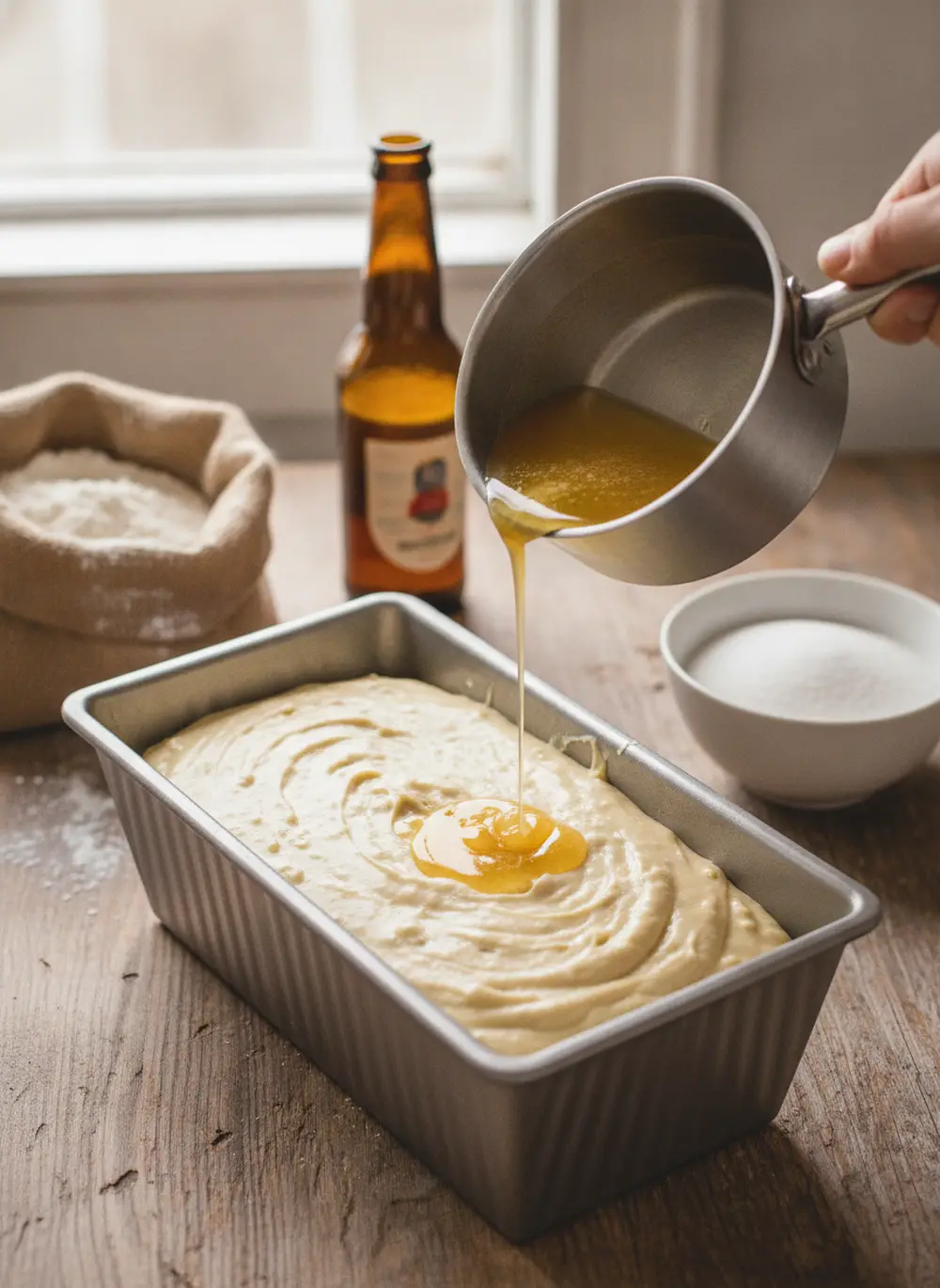
- Pour melted butter evenly over the surface.
- Bake until deep golden brown and a skewer comes out clean, then cool before slicing.
Beer Bread
A one-bowl, no-yeast quick bread — the beer’s carbonation does the lifting, and a butter-topped crust does the rest.
Ingredients
- 3 cups self-rising flour (or 3 cups all-purpose flour + 1 tablespoon baking powder + 1 teaspoon salt)
- 3 tablespoons granulated sugar
- 1 can or bottle (12 ounces) beer, any kind, opened just before mixing
- 1/4 cup (4 tablespoons) unsalted butter, melted
Instructions
- Preheat the oven to 375°F (190°C). Grease a 9×5-inch loaf pan.
- In a large bowl, whisk the self-rising flour and sugar together until evenly combined.
- Open the beer and pour it in. Stir with a spatula just until the flour disappears — the batter will be thick, sticky and a little lumpy. Do not overmix, or the crumb turns tough and gummy.
- Scrape the batter into the prepared pan and smooth the top with the spatula.
- Pour the melted butter evenly over the top of the batter — it will pool and run down the sides, which is exactly what you want.
- Bake for 45–55 minutes, until the top is deep golden brown and a skewer inserted in the center comes out clean.
- Cool in the pan for 10 minutes, then turn out onto a wire rack and cool at least 20 minutes more before slicing. Cutting it hot crumbles the loaf.
Which beer to use
Almost any carbonated beer works, and the one you pick changes the flavor more than the texture. If you’re not sure, a lager is the safest, most crowd-pleasing choice.
| Beer Type | Flavor In The Loaf | Best For |
|---|---|---|
| Lager or Pilsner | Light, mild, barely noticeable | Classic sandwich bread, cheese versions |
| Amber or Brown Ale | Nutty, malty sweetness | Everyday loaves, savory herb versions |
| Stout or Porter | Rich, dark, faint molasses note | Sweet or chocolate-forward variations |
| Wheat Ale | Soft, slightly fruity | Cinnamon or honey versions |
| IPA | Noticeably bitter once baked | Use sparingly — can overpower the loaf |
| Non-alcoholic beer | Milder, still works fully | Anyone skipping alcohol |
Pan sizes and bake times
| Pan | Bake Time | Notes |
|---|---|---|
| 9×5-inch loaf pan (standard) | 45–55 minutes | The recipe as written |
| 8×4-inch loaf pan | 50–60 minutes | Taller loaf, check the center carefully |
| Two 8×4-inch pans (double batch) | 40–45 minutes | Shorter, wider loaves bake faster |
| Muffin tin (12 count) | 20–25 minutes | Great for individual servings or a crowd |
Common problems and how to fix them
| Problem | Likely Cause | Easy Fix |
|---|---|---|
| Dense, heavy loaf | Flat beer — opened too long before mixing | Use a freshly opened can or bottle, and mix right after opening |
| Doesn’t rise at all | Used plain flour with no added leavening | Confirm the bag says “self-rising,” or add 1 Tbsp baking powder + 1 tsp salt per 3 cups all-purpose |
| Gummy or tough crumb | Overmixed the batter | Stir only until the flour disappears — a lumpy batter is correct, not a mistake |
| Butter pools and burns on top | Too much butter, or oven runs hot | Stick to 1/4 cup, and check at the 40-minute mark if your oven runs hot |
| Noticeably bitter aftertaste | A very hoppy IPA was used | Switch to a lager, amber ale, or stout for a milder background flavor |
| Sinks in the middle | Underbaked, or batter overfilled the pan | Bake until deep golden and a skewer comes out clean; don’t fill the pan past two-thirds full |
Variations and customizations
- Cheddar jalapeño. Fold in 1 cup shredded cheddar and 1–2 minced jalapeños before baking.
- Herb and garlic. Add 1 teaspoon garlic powder and 2 teaspoons dried rosemary or thyme to the dry ingredients.
- Honey butter. Swap the sugar for 2 tablespoons honey, and brush warm slices with honey butter.
- Sweet cinnamon. Use a wheat ale, and add 1 teaspoon cinnamon plus an extra 2 tablespoons sugar.
- Gluten-free. Use a self-rising gluten-free flour blend — the beer still provides the carbonation either way.
- Non-alcoholic. Substitute a non-alcoholic beer, or sparkling water plus an extra 1/4 teaspoon baking powder for lift.
Tips for the best results
- Use fresh self-rising flour. Its leavening power fades after several months in the pantry — check the date if the loaf has ever come out flat before.
- Don’t skip the butter topping. It seals in moisture and produces the crackly, golden crust that makes this bread recognizable.
- Let it cool before slicing. Cutting it hot releases steam too fast and crumbles the crumb; 20–30 minutes makes a real difference.
- Room-temperature beer mixes more evenly than beer straight from the fridge, though either works.
What to serve it with
Beer bread’s mild, malty flavor makes it one of the more versatile loaves in the rotation. Warm slices with butter are enough on their own, but it also holds up well next to a bowl of chili or beef stew, where it’s sturdy enough to mop up the last of the broth without falling apart. Toasted the next day, it makes a solid base for grilled cheese, and a slice alongside a cheese board does the same job as a baguette with a little more character. The cheddar-jalapeño variation in particular pairs naturally with anything smoky off the grill.
Storage
Wrapped in foil or an airtight container, beer bread keeps on the counter for 2–3 days. Refrigerating extends it to about a week, though the crumb dries out faster in the fridge. For longer storage, wrap the whole loaf or individual slices tightly and freeze for up to 3 months — thaw at room temperature or toast slices straight from frozen.
For more no-yeast baking that skips the wait, our quick bread basics guide covers the same shortcuts this recipe relies on, and banana bread is another one-bowl loaf worth keeping in the regular rotation. If you’d rather go savory, our savory garlic bread uses a similar no-fuss approach.
Frequently Asked Questions
Does the alcohol cook out of beer bread?
Most of it, but not all. An hour in the oven bakes off roughly 65–80% of the alcohol, similar to other dishes made with wine or beer — a small trace does remain. If you’re serving it to children or want to avoid alcohol entirely, use a non-alcoholic beer instead; it still carbonates the batter the same way.
What is the best beer for beer bread?
A lager or amber ale gives the most balanced, crowd-pleasing flavor. Stouts add a richer, slightly sweet note that works well in dessert-style versions. Avoid very hoppy IPAs — baking concentrates their bitterness and it can overpower the loaf.
Can I make beer bread without self-rising flour?
Yes. For every 3 cups of all-purpose flour, whisk in 1 tablespoon baking powder and 1 teaspoon salt before adding the beer. Self-rising flour is simply that combination pre-measured.
Why is my beer bread dense?
Almost always flat beer — if it sat open for a while or was poured too far ahead of time, most of the carbonation that lifts the loaf is already gone. Open the beer immediately before mixing, and stir the batter only until the flour disappears; overmixing also compacts the crumb.
Can I make it without alcohol?
Yes — substitute a non-alcoholic beer, which is still carbonated, or use sparkling water/club soda with an extra 1/4 teaspoon baking powder added for lift. The flavor will be milder without the malt character, but the texture holds up.
Can I freeze beer bread?
Yes. Wrap the whole loaf or individual slices tightly in plastic wrap and a freezer bag, and freeze for up to 3 months. Thaw at room temperature, or toast slices directly from frozen.
One can, one bowl, one loaf
Beer bread earns its place as the fastest homemade bread worth making: four ingredients, ten minutes of hands-on time, and no yeast to proof. Keep the beer fresh, don’t overmix, and you’ll have a warm, golden loaf on the counter before a yeast dough would even finish its first rise.