

You spent all that time on a beautiful loaf — blistered crust, open airy crumb, that unmistakable tang — and by tomorrow afternoon it has gone soft, or worse, gone stale. Knowing how to store fresh sourdough bread is the difference between a loaf that stays good for days and one that disappoints you within hours.
The frustrating part is that most bread storage advice is flatly wrong for sourdough. Plastic bags, bread bins, and (worst of all) the fridge each do something specific and unhelpful to a naturally leavened loaf. This guide covers what actually works, why it works, and exactly how long each method keeps your bread at its best.
Why sourdough stores differently to other bread
Two things make sourdough its own case. First, that thick, crisp crust is not just for looks — it is a natural moisture barrier protecting the crumb inside. Anything that softens the crust (sealed plastic, humidity, the fridge) undoes the loaf’s own defence system.
Second, sourdough is naturally preserved. The lactic and acetic acids produced during a long fermentation lower the bread’s pH, which slows mould growth considerably. That is why a real sourdough loaf stays edible for days without a single preservative, while ordinary sandwich bread relies on additives to do the same job.
The single biggest mistake? Putting sourdough in the fridge. It feels sensible — cold slows mould, surely? — but refrigerator temperatures sit right in the sweet spot for starch retrogradation, the process where starch molecules recrystallise and the bread goes stale. Sourdough goes stale roughly three times faster in the fridge than on the counter. The freezer is fine, because it is cold enough to skip past that zone entirely. The fridge is the worst of both worlds.
Storage methods compared
Here is how each method actually performs, and when to reach for it:
| Method | Keeps For | What Happens To The Loaf |
|---|---|---|
| Cut-side down on a board | 1–2 days | Best crust of any method. The cut face seals against the board while the crust breathes. Ideal for day one and two. |
| Linen or cotton bread bag | 2–4 days | The sweet spot. Fabric breathes enough to keep the crust crisp while slowing moisture loss from the crumb. |
| Paper bag | 1–2 days | Crust stays lovely and crisp, but paper wicks moisture, so the crumb dries faster than in linen. |
| Bread box | 2–3 days | Decent middle ground. Traps some humidity, so the crust softens a little but the crumb stays moist. |
| Freezer (sliced) | Up to 3 months | The only genuinely long-term option. Texture is nearly perfect once toasted. |
| Plastic bag | 2–3 days | Crumb stays soft but the crust goes completely leathery, and trapped moisture invites mould. |
| Refrigerator | Not recommended | Stales roughly 3× faster than the counter. Avoid unless your kitchen is very hot and humid. |
Days one and two: cut-side down
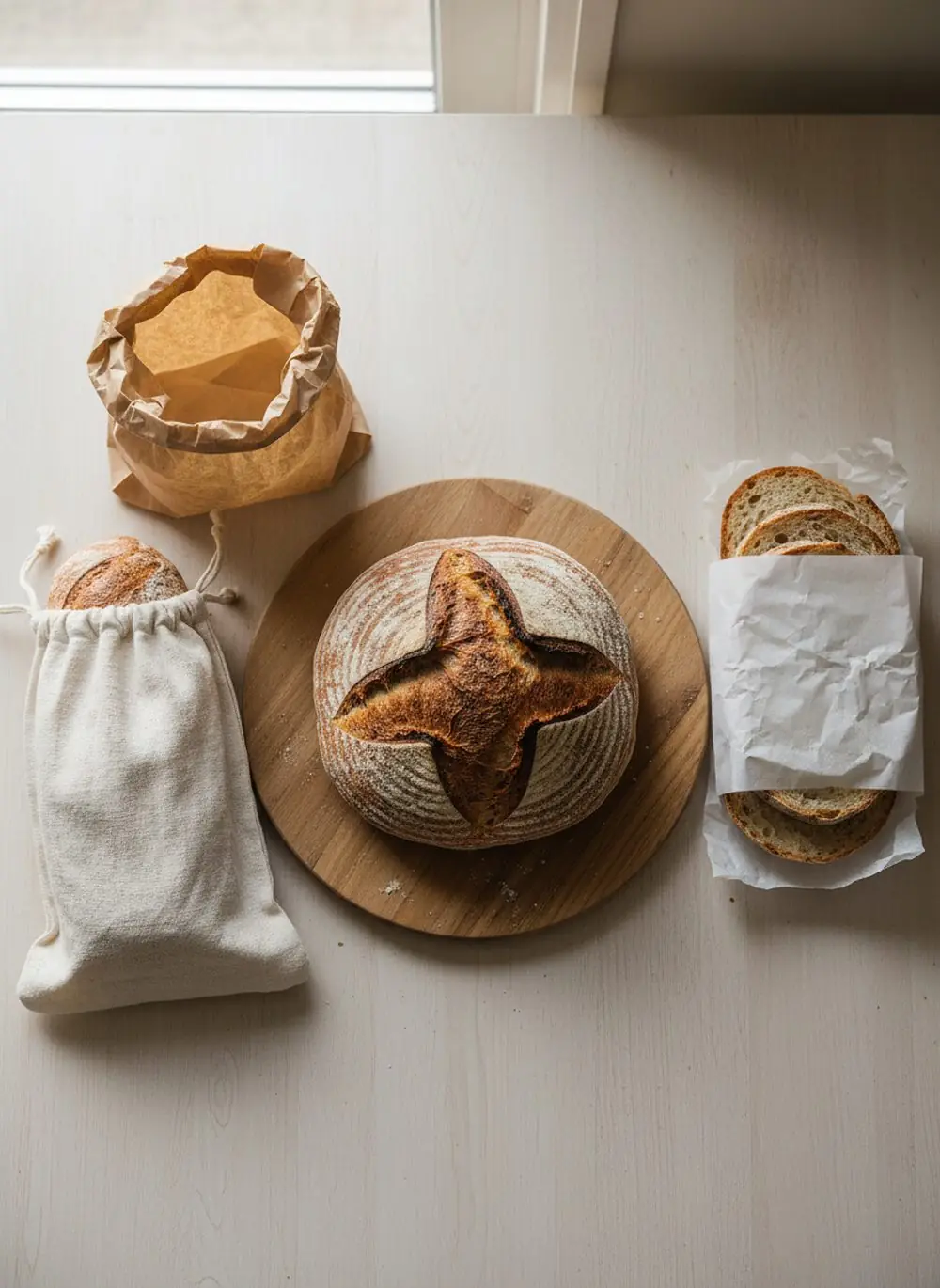
For the first 48 hours, the best storage is almost no storage at all. Leave the loaf out at room temperature, cut-side down on a wooden board or bench. The flat cut face seals itself against the surface, which stops the crumb drying out, while the crust stays exposed to air and keeps its crackle.
Do not wrap it, do not bag it, and resist slicing more than you need. Every cut you make creates another exposed surface losing moisture. Cut from the middle and push the two halves back together if you want to be really careful about it.
Days two to four: a linen bread bag
Once the loaf is a couple of days old, it needs a little help retaining moisture — but not so much that the crust suffocates. A linen or cotton bread bag is the ideal balance, which is precisely why bakeries have used cloth for centuries. The weave lets water vapour escape slowly instead of condensing on the crust.
No bread bag? A clean tea towel wrapped around the loaf does virtually the same job. A paper bag is the next best option, though paper draws moisture out faster, so expect the crumb to dry a day sooner.
Beyond four days: freeze it
Freezing is the only method that genuinely preserves sourdough long term, and done properly the results are excellent — far better than most people expect. The trick is to slice before freezing. A whole frozen loaf takes hours to thaw and forces you to defrost the lot; individual slices go straight from freezer to toaster.
Wrap the slices tightly in baking paper or beeswax wrap, then place them in a freezer bag with the air pressed out. Double protection prevents freezer burn, which is what causes those dry, cardboard-tasting edges. Frozen this way, sourdough keeps its quality for around three months.
To use, toast slices straight from frozen — no thawing needed, just add 30 seconds or so to your usual setting. If you froze a whole loaf, thaw it at room temperature still wrapped (unwrapping traps condensation on the crust), then refresh it in the oven as described below.
How to revive a stale sourdough loaf
Here is the trick that feels like magic the first time you try it: stale sourdough can be brought back to life with water and heat. Staling is starch recrystallisation, and that process is largely reversible with moisture and temperature.
- Run the whole loaf briefly under cold water — yes, really. A quick pass to dampen the crust, not a soak.
- Bake at 180°C (350°F) for 10–15 minutes, directly on the oven rack.
- Cool for a few minutes before slicing. The crust crisps up, the crumb softens, and it tastes close to freshly baked.
The one catch: a revived loaf goes stale again quickly, usually within hours. Refresh only what you plan to eat that day.
Common problems and how to fix them
| Problem | Likely Cause | Easy Fix |
|---|---|---|
| Crust went soft and leathery | Stored in plastic or a sealed container | Switch to linen, paper, or cut-side down. Re-crisp in a 180°C oven for 8–10 minutes. |
| Bread went stale within a day | Stored in the refrigerator | Never refrigerate sourdough. Counter for 2–4 days, freezer beyond that. |
| Mould after 2–3 days | Warm humid kitchen, or loaf bagged while still warm | Cool completely (4–6 hours) before storing, and freeze what you cannot eat in three days. |
| Crumb dried out but crust is fine | Paper bag, or too many cut surfaces exposed | Move to a linen bag and keep the cut face pressed against a board. |
| Freezer slices taste dry and off | Freezer burn from poor wrapping | Double wrap: baking paper first, then a freezer bag with the air squeezed out. |
| Loaf sweated inside its bag | Bagged while still warm from the oven | Always cool completely first — trapped steam is what creates mould. |
The rules that matter most
- Cool it completely before storing. A loaf takes 4–6 hours to finish cooling, and bagging it warm traps steam — the fastest route to mould.
- Never refrigerate. This is the single most damaging thing you can do to a sourdough loaf.
- Cut side down, always. Whatever else you do, keep the exposed crumb face against a flat surface.
- Slice as you go. Cut only what you are about to eat; every new cut is another drying surface.
- Freeze early, not late. Freeze on day two or three while the loaf is still good, rather than trying to rescue it on day five.
What to do with sourdough past its best
Even properly stored bread eventually reaches the end of its comfortable eating life — and stale sourdough is genuinely useful rather than a failure. Blitz it into breadcrumbs and freeze them; they crisp beautifully and are excellent on pasta. Cube and toast it for croutons that outclass anything shop-bought. Or use thick slices for French toast, where slightly dry bread actually performs better because it soaks up custard without collapsing.
Stale sourdough is also the traditional base for panzanella, ribollita, and bread pudding — all dishes invented specifically to use up day-old loaves. And a thick slice of revived sourdough is the ideal partner for our savoury garlic bread treatment, or for mopping up the sauce from Marry Me Chicken.
If you like keeping a living culture on the counter, our ginger bug works on the same principle — wild yeast, daily feeding, and homemade fizzy soda at the end of it.
Frequently Asked Questions
Should I store sourdough bread in the fridge?
No — the refrigerator is the worst place for sourdough. Fridge temperatures accelerate starch retrogradation, the process that makes bread stale, so a loaf goes stale roughly three times faster than it would on the counter. Use the counter for short term and the freezer for long term.
How long does fresh sourdough bread last?
Stored properly at room temperature, a sourdough loaf stays good for 2–4 days — longer than most bread, because fermentation acids naturally slow mould growth. Cut-side down keeps it best for the first two days; a linen bag extends it to about four. Frozen, it keeps around three months.
What is the best way to store sourdough to keep the crust crispy?
Leave it out at room temperature, cut-side down on a wooden board, with nothing wrapped around it. The crust needs air to stay crisp — any sealed container or plastic bag traps moisture and turns it leathery within hours.
Can you freeze sourdough bread?
Yes, and it is the best long-term option. Slice the loaf first, wrap the slices in baking paper, then seal them in a freezer bag with the air pressed out. Toast straight from frozen — no thawing required. Quality holds for about three months.
How do I revive stale sourdough?
Run the whole loaf quickly under cold water to dampen the crust, then bake at 180°C (350°F) for 10–15 minutes. The moisture and heat reverse the staling process and the loaf comes out crisp outside and soft inside. Eat it the same day, as it will stale again quickly.
Why did my sourdough go mouldy so quickly?
Almost always because it was stored before it had fully cooled, trapping steam inside the bag, or because the kitchen is warm and humid. Let the loaf cool for 4–6 hours before storing, choose a breathable wrap, and freeze whatever you will not eat within three days.
Is a bread box good for sourdough?
It is a reasonable middle ground, keeping bread for 2–3 days. A bread box traps a little humidity, so the crumb stays moist but the crust softens slightly compared with open-air storage. For the crispest crust, cut-side down on a board still wins.
Bring it to the table
Sourdough rewards a little care. Cool it completely, keep it cut-side down for the first couple of days, move it into linen after that, and freeze anything you will not finish within three or four days — and skip the fridge entirely. Do that, and the loaf you worked hard on will taste every bit as good on day three as it did coming out of the oven. Save this guide to Pinterest for your next bake!